
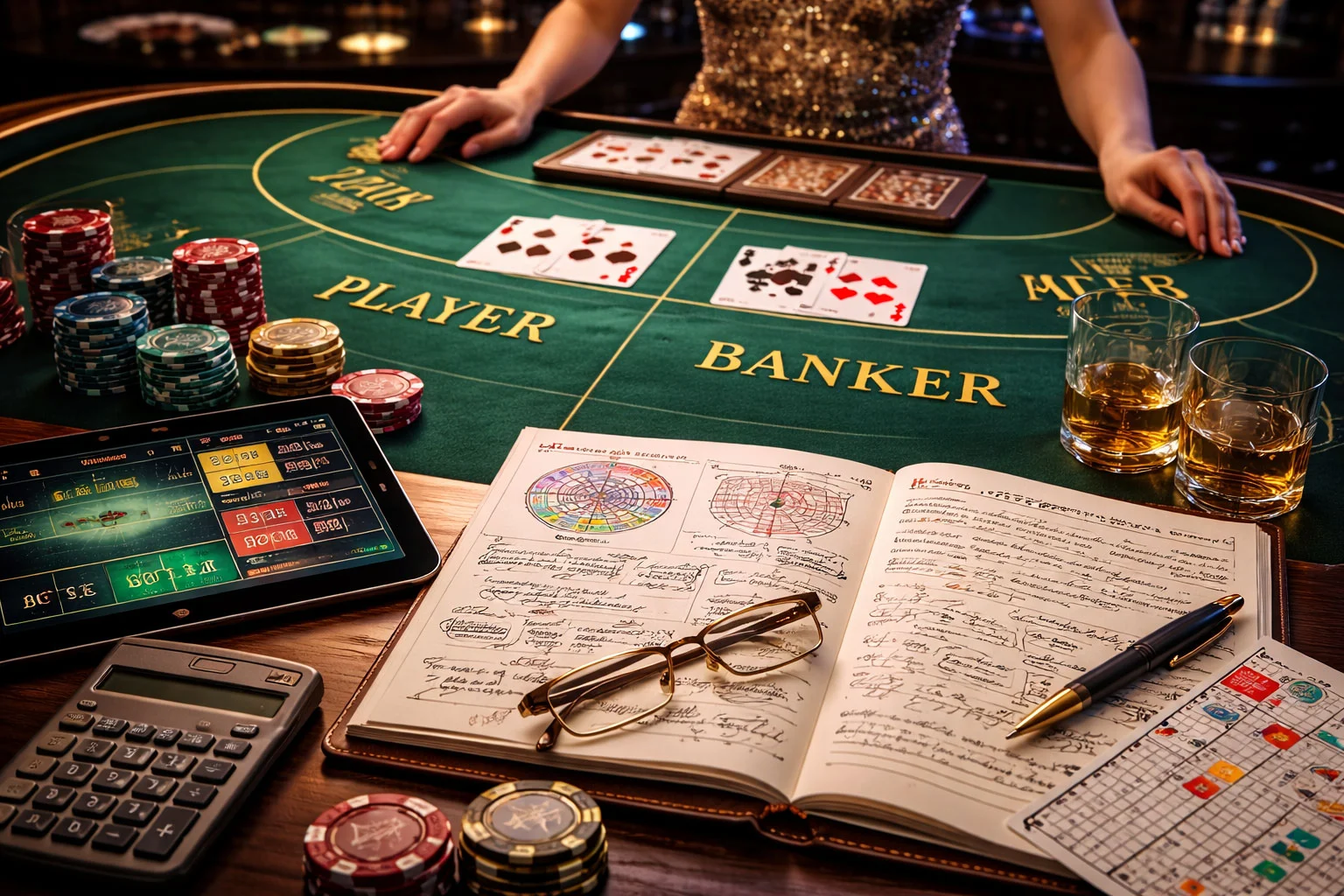
Baccarat has long held a reputation as the game of the elite, often depicted in high-stakes environments where composure and intuition are the primary tools of the trade. While its origins are steeped in European history, the modern incarnation of the game has found a massive audience in the digital sphere. Unlike many other card games that rely on complex bluffing or physical tells, Baccarat is a game of pure mathematical probability and elegant simplicity, making it a perfect fit for the contemporary online environment.
The Mathematical Foundation of the Game
At its core, Baccarat is a comparison game played between two hands: the "Player" and the "Banker." Each round of play, known as a coup, has three possible outcomes: the Player has the higher score, the Banker has the higher score, or a tie. The goal is to bet on the hand that will achieve a total closest to nine.
The beauty of the game lies in its fixed rules. Unlike Blackjack, where a player’s decision to hit or stand can drastically alter the house edge for everyone at the table, Baccarat follows a strict protocol known as the "Tableau." These rules dictate exactly when a third card is drawn based on the initial totals. Because these rules are predetermined, the house edge is remarkably low and remains consistent. This transparency is a major draw for analytical players who prefer to manage their bankroll based on known variables rather than the unpredictable behavior of other participants.
Transitioning to the Digital Arena
The shift from velvet-lined VIP rooms to high-definition screens has changed the accessibility of the game without sacrificing its inherent tension. Digital platforms have introduced various versions of the game, including Punto Banco, Baccarat Chemin de Fer, and Baccarat Banque. In the Australian market, the convenience of accessing these variants has led to a surge in popularity. Players can now engage with stellarspins baccarat online at any time, benefiting from interfaces that track history, display patterns (often referred to as "roads"), and provide instant payouts.
The digital format also allows for lower minimum bets compared to brick-and-mortar establishments. In a physical venue, the labor costs of dealers and the physical space of the table often necessitate high minimums. Online, these overheads are reduced, allowing casual enthusiasts to enjoy the same statistical advantages previously reserved for high rollers.
Analyzing the Banker’s Advantage
One of the most discussed topics in Baccarat strategy is the "Banker Bet." Statistically, the Banker hand wins slightly more often than the Player hand—approximately 45.8% of the time compared to 44.6% for the Player (with ties making up the remainder). To offset this advantage, most platforms charge a 5% commission on winning Banker bets.
Despite this commission, many professional gamblers argue that the Banker bet remains the most logical choice. Even with the 5% fee, the house edge on a Banker bet is roughly 1.06%, while the Player bet carries a house edge of about 1.24%. While the difference may seem negligible in a single session, over thousands of hands, the mathematical reality favors the Banker. The "Tie" bet, conversely, often carries a house edge exceeding 14%, leading many veterans to view it as a high-risk gamble rather than a strategic move.
The Evolution of Live Dealer Technology
Perhaps the most significant advancement in the online space is the introduction of Live Dealer Baccarat. By using real-time video streaming, players can watch a professional dealer flip physical cards in a studio. This adds a layer of trust and social interaction that purely software-based games sometimes lack. It recreates the ritual of the "squeeze"—where the cards are revealed slowly to heighten the drama—a tradition deeply cherished in land-based venues.
Conclusion
Baccarat remains a timeless classic because it balances high-octane excitement with a low house edge and straightforward rules. As it continues to evolve within the digital landscape, it maintains the same sense of prestige it had in the 19th-century salons of France. For the modern player, the game represents an ideal blend of tradition and technology, providing a sophisticated experience that is both mathematically fair and deeply engaging.